The GovTech 100's Most Prolific Winners: Who Keeps Making the List, and Why


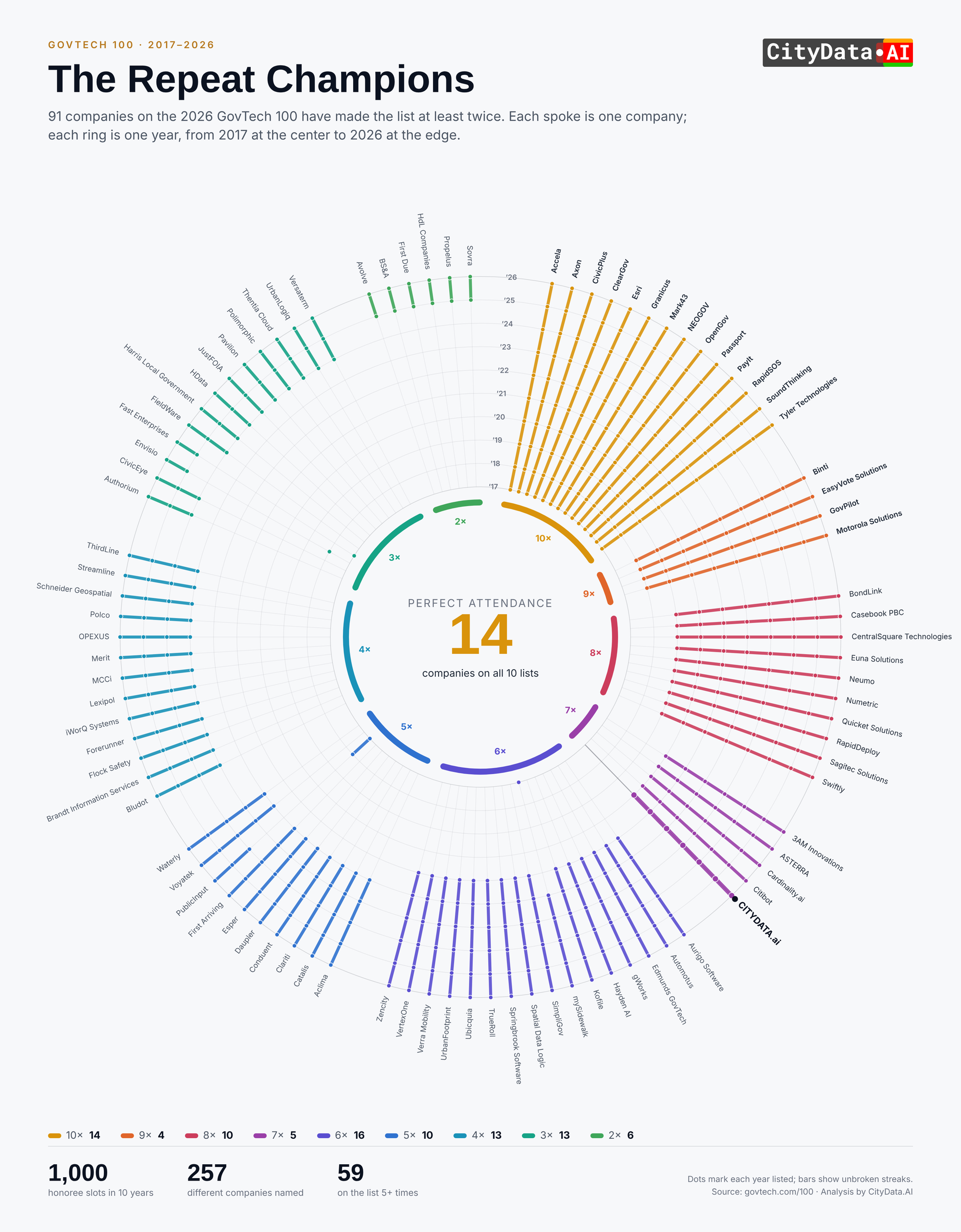
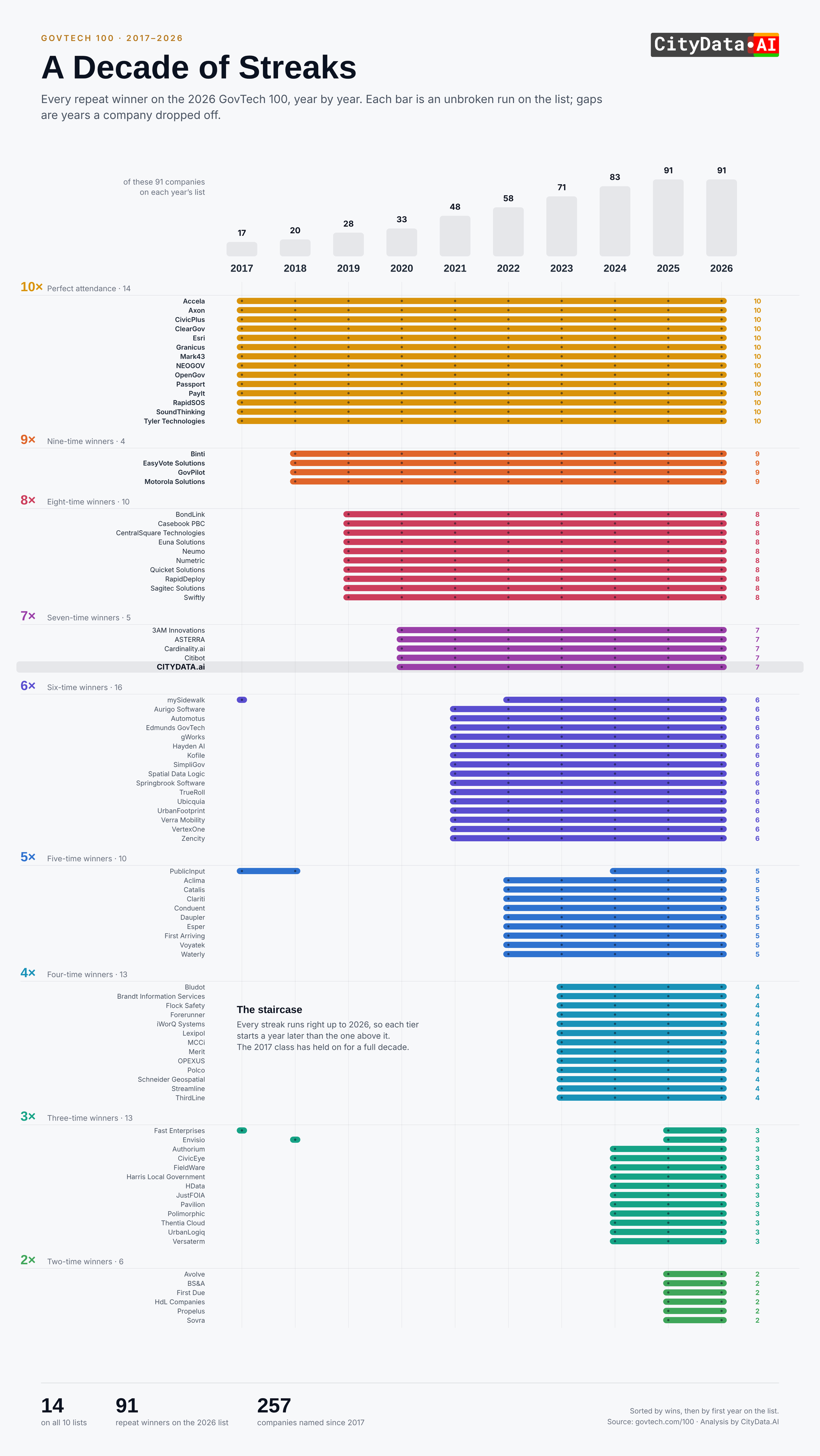
Only 14 companies have made all ten GovTech 100 lists from 2017 to 2026. Across those ten years, Government Technology named 1,000 honorees, but just 257 different companies filled those slots, and most appeared once or twice.
This post looks at the other end of that curve: the 59 companies on the 2026 list that have now been named five or more times. Who are they, how big are they, who funds them, and how many of them are building with AI? And what does it take to stay on the list year after year?
How we counted
We pulled every company from the ten published lists at govtech.com/100 and matched them across years. Companies that changed names count as one company, for example ShotSpotter and SoundThinking, or GTY Technology and Euna Solutions. A "prolific winner" here is a company on the 2026 list that has been named at least five times.
We then compared the 59 prolific winners on eight attributes:
- Years in business: founding year to 2026.
- Company size: estimated employees.
- Funding or ownership deals: venture rounds, private equity buyouts and acquisitions.
- Estimated annual revenue: reported figures for public companies, ranges for private ones.
- Ownership: public, private equity, venture-backed, strategic or privately held.
- Market reach: US only, North America or global.
- Headquarters country.
- AI focus: Core (AI is the product), Significant (major AI capabilities), Emerging (AI features being added) or Limited.
Public-company figures come from annual reports and filings. Most private-company figures are estimates from press coverage and company materials, so treat them as directional.
The prolific winners
Fifty-nine companies on the 2026 list have been named five or more times. Here they are by number of appearances.
Times on the list | Companies |
|---|---|
10 of 10 (14) | Accela, Axon, CivicPlus, ClearGov, Esri, Granicus, Mark43, NEOGOV, OpenGov, Passport, PayIt, RapidSOS, SoundThinking, Tyler Technologies |
9 (4) | Binti, EasyVote Solutions, GovPilot, Motorola Solutions |
8 (10) | BondLink, Casebook PBC, CentralSquare Technologies, Euna Solutions, Neumo, Numetric, Quicket Solutions, RapidDeploy, Sagitec Solutions, Swiftly |
7 (5) | 3AM Innovations, ASTERRA, Cardinality.ai, Citibot, CityData.AI |
6 (16) | Aurigo Software, Automotus, Edmunds GovTech, gWorks, Hayden AI, Kofile, mySidewalk, SimpliGov, Spatial Data Logic, Springbrook Software, TrueRoll, Ubicquia, UrbanFootprint, Verra Mobility, VertexOne, Zencity |
5 (10) | Aclima, Catalis, Clariti, Conduent, Daupler, Esper, First Arriving, PublicInput, Voyatek, Waterly |
A few of these counts include earlier names: SoundThinking (ShotSpotter), Granicus (GovDelivery, 2017), Euna Solutions (GTY Technology), ASTERRA (Utilis), Catalis (Government Brands), Voyatek (GCOM) and Neumo (likely Avenu Insights & Analytics).
What the data shows
Staying power on the GovTech 100 does not depend on size. The prolific winners range from Motorola Solutions, with about $10.8 billion in 2024 revenue and some 21,000 employees, to teams of fewer than 50 people.
Five patterns stand out:
- They are established but not old. The median prolific winner is 13 years old. Only five were founded before 1990, and 11 were founded in 2017 or later.
- Capital comes in every form. Venture money backs the most companies, but private equity now owns many of the largest, including Granicus, NEOGOV, Accela and CentralSquare. Six are public, and OpenGov belongs to Cox Enterprises after a 2024 deal at a $1.8 billion valuation.
- The market is still mostly American. Only three of the 59 have roots outside the US: ASTERRA and Zencity in Israel, and Clariti in Canada. About one in five (13) sells globally.
- AI has moved to the center. Ten companies are AI-native, meaning AI is the product. Another 15 have significant AI capabilities, and 22 more are adding AI features.
- Specialists can last as long as platforms. BondLink (municipal bonds), EasyVote (elections) and Numetric (traffic safety) have each made the list eight or nine times while serving one niche.
The standouts
A handful of prolific winners break the pattern on at least one dimension.
Company | Times on list | What makes it unusual |
|---|---|---|
Motorola Solutions | 9 | The largest company on the list, with about $10.8 billion in 2024 revenue. |
Esri | 10 | Founded in 1969 and still founder-owned. It remains privately held by its founders and sets the standard for government GIS. |
RapidSOS | 10 | A govtech unicorn. It raised $100 million in late 2025 at a valuation above $1 billion, after supporting more than one billion emergencies. |
OpenGov | 10 | Acquired by Cox Enterprises in 2024 at a $1.8 billion valuation, one of the largest disclosed deals among the prolific winners. |
Hayden AI | 6 | Founded in 2019 and on every list since 2021. It has raised about $150 million for computer vision on buses. |
ASTERRA | 7 | The only prolific winner headquartered in Israel. It uses satellite radar and AI to find water leaks, with more than 100,000 found by 2023. |
EasyVote Solutions | 9 | A small, focused election software company that has kept pace with giants for nine years. |
CityData.AI | 7 | On every list since 2020 with no priced equity round, and the only top-tier company built on AI models of how people move. |
The common thread is focus. Each standout owns a clear problem, whether that is 911 data, election administration, water loss or bus lanes.
Profiles: the AI-focused winners
Ten of the 59 prolific winners are AI-native, and AI is reshaping many of the rest. These eight show the range.
RapidSOS: AI for 911 (10 of 10)
RapidSOS links data from phones, cars and apps to 911 centers, and now applies AI to help call-takers act faster. It has supported more than one billion emergencies and raised $100 million in 2025, putting its valuation above $1 billion.
Axon: AI in the patrol car (10 of 10)
Axon grew from TASER devices into a platform of body cameras, evidence software and AI tools such as automated report drafting. Revenue reached about $2.8 billion in 2025.
SoundThinking: acoustic AI (10 of 10)
Formerly ShotSpotter, SoundThinking uses machine learning on acoustic sensors to detect and locate gunfire, then adds investigative analytics. It is one of six public companies among the prolific winners.
Hayden AI: computer vision on buses (6)
Hayden AI mounts cameras on transit buses to keep bus lanes and stops clear. Founded in 2019, it has been on every list since 2021 and raised a $90 million Series C in 2024.
Zencity: AI that listens to residents (6)
Zencity analyzes surveys, social media and service requests to show local leaders what residents think. Founded in Tel Aviv and now based in New York, it raised a $40 million Series C in 2024.
ASTERRA: AI from orbit (7)
ASTERRA reads satellite radar with AI to find underground water leaks and infrastructure risk. Its customers span dozens of countries, and it passed 100,000 detected leaks in 2023.
Ubicquia: AI on the streetlight (6)
Ubicquia turns streetlights and utility poles into sensing nodes for cities and grids. It raised a $106 million Series D in February 2026 to expand its AI-driven infrastructure platform.
Citibot and Cardinality.ai: AI for service delivery (7 each)
Citibot gives local governments generative AI chat and text services for residents. Cardinality.ai builds AI-powered software for health and human services agencies. Both have made seven straight lists.
Why CityData.AI is different
CITYDATA.ai has been on every GovTech 100 list since 2020, seven in a row, in the same tier as Citibot, ASTERRA, Cardinality.ai and 3AM Innovations. Many prolific winners share one or two of the traits below. Together, all seven set CITYDATA.ai apart.
- It builds its own AI. CITYDATA.ai does not just wrap commercial frontier models. Its in-house research team builds proprietary models: one for visitation and movement in parks, trails and open spaces, one for footfall in downtowns and business districts, and a new model for road traffic and transit ridership. Each is calibrated against ground truth from counters, sensors and field surveys.
- It measures how people move. Most prolific winners digitize a government workflow such as permits, payroll or records. CITYDATA.ai measures how residents and visitors actually use public places, a question agencies could once answer only with manual counts and surveys.
- It covers the whole map. Coverage spans every US county and cities in more than 100 countries, so an agency can start on day one without installing hardware. One platform serves state park systems, downtown and economic development programs, and transportation and transit agencies.
- It serves the public good, and only the public good. Its customers are state and local governments, academic research institutions and nonprofit organizations. It takes on private-sector work only when the project is tied to a public-sector one. Customers include the Indiana Department of Natural Resources, Arizona State Parks and Trails and Sonoma County Regional Parks.
- Privacy is built in from the start. Customers receive only aggregated, anonymized insights that comply with regional privacy regulations such as CCPA and GDPR. No customer ever receives device-level data.
- It grew without a priced round. Many prolific winners are backed by large venture rounds or private equity. CITYDATA.ai has never raised a priced equity round, which makes it one of the most capital-efficient companies on the list.
- It is profitable. CITYDATA.ai has been profitable, with positive cash flow, for each of the past four years. Its growth is paid for by its customers, not by investors.
For a government buyer, that combination means a partner whose incentives match the agency's own: public-sector focus, durable finances and AI built for civic questions.
What it takes to stay on the list
The prolific winners share three habits. They solve a specific government problem, they keep shipping year after year, and they keep their customers. Size, age and funding source matter far less than consistency.
The next wave is visible in the data. Eleven of the 59 were founded in 2017 or later, and AI-native companies such as Hayden AI, TrueRoll and Zencity are already on their sixth list. Expect the 2027 list to reward companies that turn AI into measurable public outcomes.